Australia Declares NASAMS Fully Operational
The system replaces the army's RBS-70 as its main air defense weapon.
- Buyer
- Australia, Australian Army
- Seller
- Kongsberg; Raytheon; CEA Technologies
- System
- NASAMS, Short Range Ground Based Air Defence project
- Announced
- September 9, 2026
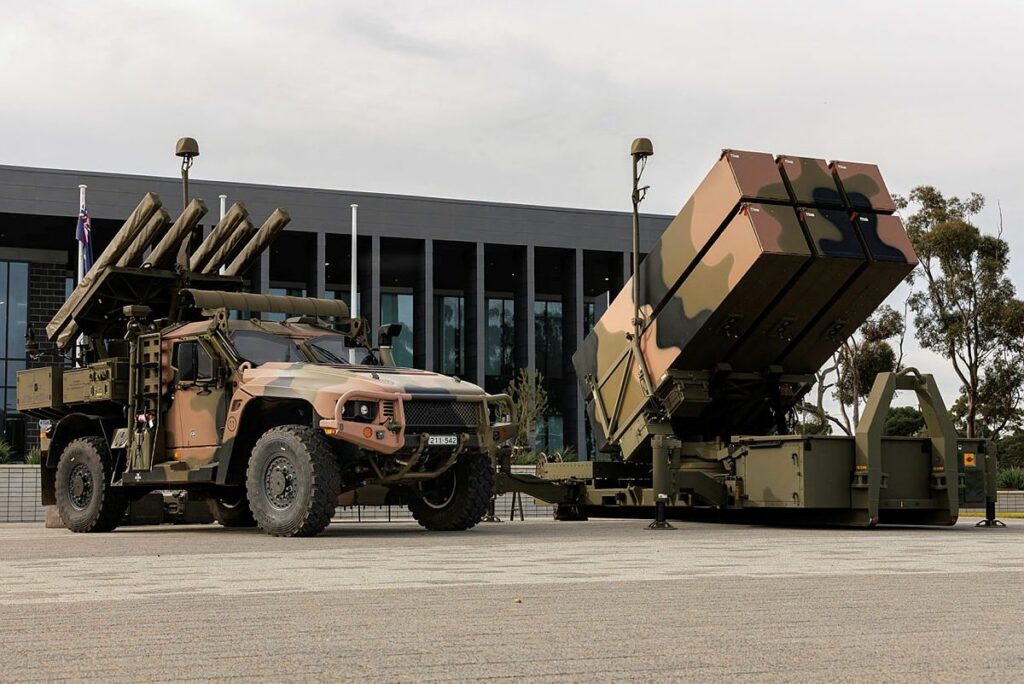
The Australian Army’s NASAMS air defense system has reached final operational capability, the Australian government said on September 9.
The milestone means the system has met its requirements and is ready for missions.
NASAMS was delivered under the Short Range Ground Based Air Defence project. It forms the inner layer of Australia’s Joint Integrated Air and Missile Defence capability. It replaces the army’s older short-range air defense, including the RBS-70, as its main air defense system.
Deputy Prime Minister and Defence Minister Richard Marles said the system improves the army’s ability to protect personnel, critical assets and infrastructure from airborne threats.
An Australian version
Australia approved the project in 2017. In 2019 it changed the design to use active electronically scanned array radars from CEA Technologies of Canberra.
The Australian system differs from the standard one in three ways: the Australian radar, a launcher built on the Hawkei vehicle, and an infrared and optical sensor.
It can fire AMRAAM or Sidewinder missiles from two kinds of launcher. One is the high-mobility launcher on the Hawkei. The other is the Mk II canister launcher on an HX77 heavy truck. Each carries up to six missiles. Each NASAMS troop operates three launchers.
Australian companies integrated key components and provide sustainment in the country.
A growing user group
NASAMS, built by Kongsberg and Raytheon, keeps adding customers. Belgium signed for it in a contract worth about $1 billion at the start of October, and the Netherlands ordered more capacity the same week.

Do you build parts of these systems?
DefMatch is the Defense Capability Exchange from The Defense Post. Find your company profile, claim it, and get in front of the people buying air defense.